Vasudev Balwant Phadke: The clerk who raised India's first revolutionary army
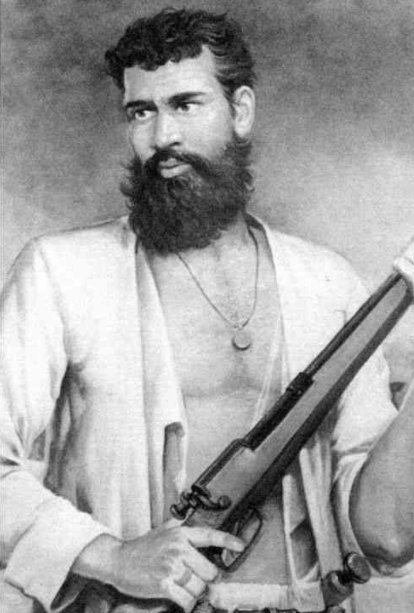
Portrait: Wikimedia Commons, CC BY-SA 4.0
Vasudev Balwant Phadke (4 November 1845 - 17 February 1883) is remembered as the father of the Indian armed rebellion, the first leader to move beyond petitions and build an underground revolutionary army against British rule. Born in Shirdhon village of Panvel taluka in Maharashtra's Raigad district, he spent fifteen years as a clerk in the military accounts department at Pune, living an ordinary colonial career until the suffering of the Deccan peasantry radicalised him. He concluded that swaraj was the only remedy for their condition, and became possibly the first Indian to tour the country for political propaganda, striking a thali with a ladle on the streets of Pune to summon crowds to his speeches at Shaniwarwada.
In 1875 he began organising in secret, drawing his recruits not from the educated elite but from the Ramoshi, Koli, Bhil and Dhangar communities. On the night of 20 February 1879, Phadke and his colleagues declared a 200-strong armed militia outside Loni, eight miles north of Pune, probably the first revolutionary army raised on Indian soil. To fund it he raided British treasuries, outposts and moneylenders. When the government put a bounty on his head after a direct engagement with colonial troops at Ghanur village, Phadke answered by announcing a bounty for the capture of the Governor of Bombay and rewards for the killing of Europeans.
Betrayed while fleeing toward Hyderabad State to recruit Rohilla and Arab fighters, he was captured after a fierce fight in a temple at Kaladgi on 20 July 1879 by a party led by British Major Henry William Daniell and Abdul Haque, the Nizam's police commissioner. Tried at Pune, where Ganesh Vasudeo Joshi, known as Sarvajanik Kaka, defended him, Phadke was undone by his own diary, which supplied the evidence for a life sentence of transportation. He was sent to the prison at Aden in Yemen. On 13 February 1883 he escaped by taking his cell door off its hinges, but he was soon recaptured, went on hunger strike, and died on 17 February 1883 at the age of thirty-seven.
Phadke's rebellion electrified Maharashtra and showed a generation that armed resistance was possible; his exploits are believed to have influenced Bankim Chandra Chattopadhyay's novel Anandamath. India honoured him with a postage stamp in 1984, and a chowk in South Mumbai near Metro Cinema bears his name, but he remains far less known than the revolutionaries he inspired.
Source: Organiser, Vajiram and Ravi, Wikipedia
Visuals: Archival portrait
Follow the daily five-post slate on Instagram.
Follow on Instagram