
Paona Brajabasi: The Manipuri Major Who Chose Death Over Treason
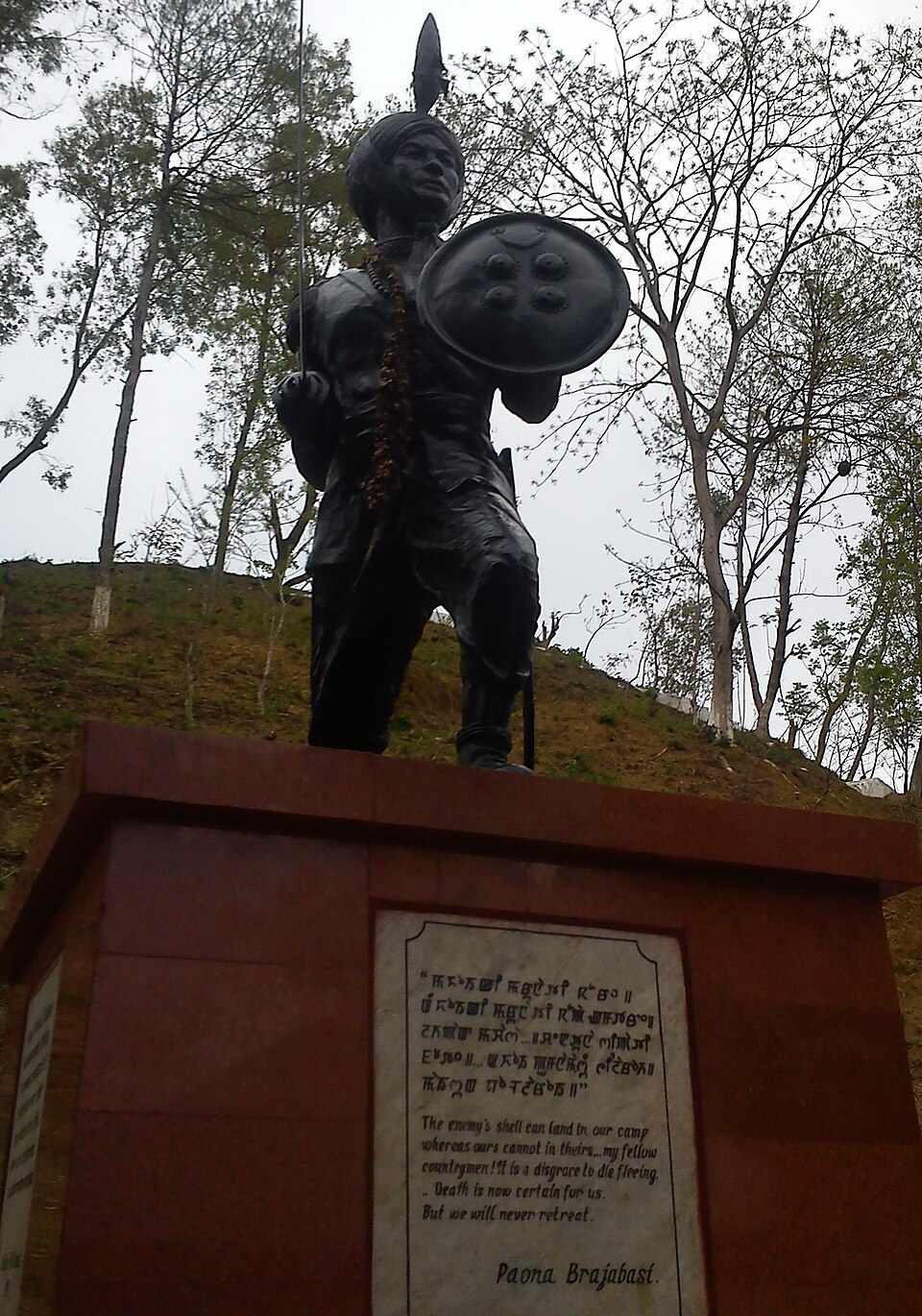
Portrait: Wikimedia Commons, CC BY-SA 3.0
Paona Brajabasi, born Paonam Nawol Singh in 1833 (some accounts give 1823), was a major in the army of the Manipur Kingdom who became the most celebrated hero of the Anglo-Manipur War of 1891. He is remembered for a single sentence, spoken on a battlefield, and for what he did immediately after saying it.
He entered the King's Army as a junior officer in 1856 and rose to the rank of major by 1891. He was a master of Thang-Ta, the traditional Manipuri martial art, trained from the age of seven under Major Loma Singh Longjamba and later under masters in Banaras and Vrindavan. He was an ally of Yuvraj Tikendrajit Singh and Thangal General, and he helped install Kulachandra Singh on the throne after the palace revolt that followed the death of Maharaja Chandrakirti in 1886.
The war came in March 1891. The British chief commissioner of Assam, James Quinton, arrived in Imphal on 22 March with 400 men to arrest Tikendrajit. Fighting broke out, a ceasefire was declared and then collapsed, and the Manipuris killed Quinton and four other British officials. The British response was a full military expedition, with columns advancing on Manipur from several directions.
Paona was sent to meet the column advancing from Tamu, on the Myanmar border. At Khongjom on 23 April 1891, he led some three to four hundred Manipuri soldiers (some accounts say seven hundred) against a far larger and better-armed British force. The Manipuris fought with shields and swords against rifles and artillery, and when their fortifications were shattered by shells, Paona charged into hand-to-hand combat wielding two swords. The resistance was so fierce that the British captain, F.M. Rundall of the 4th Gurkhas, wrote in his gallantry recommendation of 29 April that seasoned soldiers who had seen extensive combat had never witnessed such resolute and tenacious resistance. The Manipuris were overwhelmed all the same. Some accounts put their dead at 128; the British lost two men, with eleven wounded.
Paona was captured. The British commander, impressed by his bravery, offered to spare his life and give him a high post if he entered British service. Paona refused. "Death is more welcome than treason," he said, took off the cloth wrapped around his head, and offered his head to be cut off. He was executed on the battlefield on 23 April 1891.
Four days later the British entered Imphal and raised the Union Jack over the Kangla Palace. Tikendrajit and five other Manipuri commanders were executed, Kulachandra and twenty-one noblemen were exiled with their property confiscated, and the British seized close to four thousand weapons in a disarmament campaign. Manipur lost its independence.
Paona is honored every 23 April on Khongjom Day, and his statue stands at the Khongjom War Memorial, but outside Manipur his name is barely known. He was a soldier of a small kingdom fighting an empire, and the empire wrote the history.
Source: Wikipedia, The Better India, North East Now
Visuals: Archival portrait
Follow the daily five-post slate on Instagram.
Follow on Instagram
