
Pingali Venkayya: The Man Who Designed the Tricolour
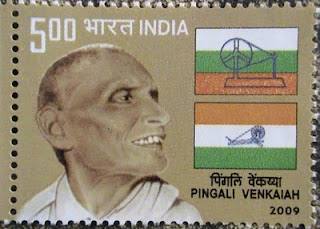
Portrait: Wikimedia Commons, CC BY-SA 4.0
Every Indian salutes a flag that Pingali Venkayya designed, and almost no Indian knows his name. He was the freedom fighter who gave the national movement its most enduring symbol, and he died in poverty in a hut, unhonoured in his own lifetime.
Venkayya was born on 2 August 1876 (a few records give 1878) at Bhatlapenumarru, a village near Machilipatnam in what is now Andhra Pradesh's Krishna district. At nineteen he joined the British Indian Army and served in South Africa during the Second Boer War of 1899 to 1902. Watching Indian soldiers salute the Union Jack, he came home convinced that a colonised nation needed a flag of its own. The 1906 session of the Congress at Calcutta, which carried the flag question into the movement's mainstream, sharpened that conviction.
Venkayya was no narrow specialist. He was a lecturer in geology at the Andhra National College in Machilipatnam, an agriculturist who researched cotton varieties, and a linguist who at one point delivered a full-length speech in Japanese. The nicknames he earned tell the story: Japan Venkayya, Patti (cotton) Venkayya, and Jhanda (flag) Venkayya. In 1916 he published a booklet offering thirty designs for an Indian flag, and between 1918 and 1921 he pressed the idea at every Congress session.
The decisive moment came on 31 March 1921, when Venkayya presented his designs to Mahatma Gandhi in Vijayawada. Gandhi asked him to design a fresh flag and wrote in Young India that Venkayya had "published a book describing the flags of countries and designed many models for our own national flag." The first design had saffron and green stripes for Hindus and Muslims; on Gandhi's suggestion a white stripe was added for other communities, with the charkha, the spinning wheel, at the centre. The Congress adopted this design with modifications in 1931, and it became the foundation of the flag the Constituent Assembly adopted in its final form on 22 July 1947.
Venkayya retired from active politics in 1922, returning to farming and education. His reward for designing the symbol of a free nation was obscurity. He died in a hut in Vijayawada on 4 July 1963. A statue was unveiled at the All India Radio building in Vijayawada only in 1998, a postage stamp came in 2009, and in 2012 the Andhra Pradesh government recommended him for a posthumous Bharat Ratna, an award that never arrived. The state government did grant his daughter, Ghantasala Sita Mahalakshmi, financial assistance of Rs 75 lakh, decades too late to help the man himself.
His forgetting is not mysterious. Venkayya belonged to no powerful lobby, held no office after 1922, and left no memoirs. The flag absorbed his identity: people wave his life's work every day without knowing the hand behind it. India got its symbol; the symbol's author was left out of the frame.
Source: The Statesman, GKToday
Visuals: Archival portrait
Follow the daily five-post slate on Instagram.
Follow on Instagram
