Tirot Sing: The Khasi Chief Who Fought a Four-Year Guerrilla War
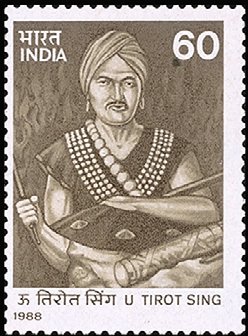
Portrait: India Post commemorative stamp (1988), Wikimedia Commons, GODL-India
U Tirot Sing Syiem, born around 1802 at Mairang in the Khasi Hills, was one of the first tribal chiefs in India to take up arms against the British. A member of the Syiemlieh clan, he was the Syiem, or chief, of Nongkhlaw, and he ruled as a constitutional head, sharing authority with a durbar, a council of representatives of the leading clans of his territory.
The trouble began with a road. After the Treaty of Yandabo in 1826 gave the British the Brahmaputra Valley, they wanted to link it to the Surma Valley by building a military road straight through the Khasi Hills. David Scott, the British political agent, asked Tirot Sing for permission, promising him control of the duars, the passes into Assam, and free trade in the region. After consulting his durbar, Tirot Sing agreed.
The agreement unraveled. The Raja of Ranee, Balaram Singh, contested Tirot Sing's possession of the duars, and the British denied him the control they had promised. Worse, Tirot Sing learned that the British were quietly reinforcing their garrisons from Guwahati and Sylhet, and a fellow chief, U Bor Manik Syiem of Shyllong, warned him of their true intentions. Tirot Sing served the British a notice to vacate Nongkhlaw. They ignored it.
On 4 April 1829, hundreds of Khasi warriors led by Tirot Sing attacked the British garrison. Two British officers were killed. The Anglo-Khasi War had begun, and it would last four years. Outnumbered and outgunned, Tirot Sing's men fought a guerrilla war, using their knowledge of the rugged hills to ambush patrols, cut supply lines, and vanish before the British could bring their superior weapons to bear. The British had to deploy thousands of troops and win over compliant Khasi chiefs before the resistance could be broken.
Tirot Sing was eventually betrayed while hiding in the caves of the hills, at Krem Siej Tyra and Krem Pyrda, and was captured in January 1833. He was not executed. He was deported to Dhaka and held there as a political and state prisoner, and he died in captivity on 17 July 1835, worn down, some accounts say by tuberculosis, by the harsh conditions of his imprisonment.
He is remembered in Meghalaya as saying he would rather die an independent king than reign as a vassal. Whether or not the words are exactly his, they capture the man. His death is commemorated every 17 July as U Tirot Sing Day, a state holiday in Meghalaya. A postage stamp honored him in 1988, and in 2024 a memorial to him was inaugurated in Dhaka, the city where he died a prisoner, as a gesture of cultural ties between Meghalaya and Bangladesh.
He is forgotten outside the Northeast because his war came early, decades before the national movement found its language, and because he died in a Dhaka jail, far from the hills he fought for.
Source: Wikipedia, India Today NE, The Shillong Times
Visuals: Archival portrait
Follow the daily five-post slate on Instagram.
Follow on Instagram