Tilka Manjhi: The Adivasi Chief Hanged for Striking at the British in 1785
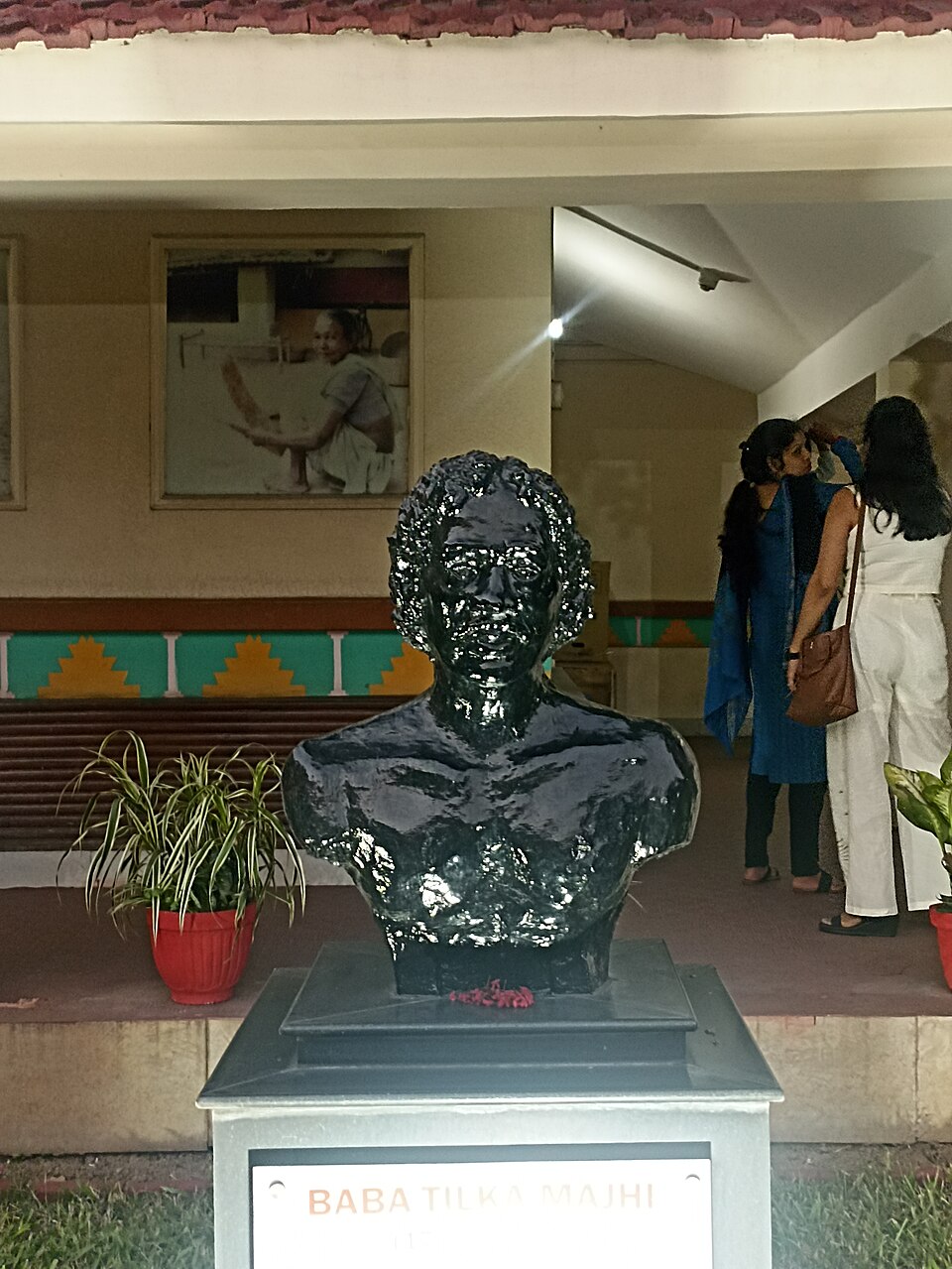
Portrait: Wikimedia Commons, CC BY-SA 4.0
Baba Tilka Manjhi, born in 1750 in the village of Tilakpur near Sultanganj in present-day Bihar, was the first Adivasi leader to take up arms against the British East India Company, roughly seventy years before Mangal Pandey and a century before 1857. He was a Santhal. Some accounts call him Jabra Paharia, and historians still debate whether the rebel recorded as Jaora Paharia and Tilka Manjhi were the same man.
Details of his early life are thin. He is said to have been the son of Sundara Murmu and to have grown up in the forests of the Rajmahal hills. The famine of 1770, which devastated the region, shaped his politics. He became a Robin Hood-like figure, looting the Company's treasury and distributing the money among the starving. The gesture drew more tribals to his cause, and between about 1771 and 1784 he kept up a guerrilla campaign against the Company and its allies, at one point wresting the Ramgarh camp from the British with a joint front of Paharia sardars.
His most famous act came in the winter of 1783-84. Augustus Cleveland, the East India Company's officer at Rajmahal, had tried a policy of conciliation toward the hill tribes, but he was still the face of Company authority. Tilka ambushed him and wounded him with a poisoned arrow. Cleveland lingered for three months, was advised to sail for the Cape of Good Hope to recover, and died in early January 1784 before his ship had even cleared the Hooghly.
The Company treated the attack as an attack on itself. A massive manhunt followed, with soldiers combing the hills and tempting villagers with gifts to betray him. It took a full year. Tilka was captured on 12 January 1785, tied to horses and dragged to the collector's residence at Bhagalpur, and hanged the next day from a banyan tree at a road junction in the town. The spot is now Tilka Manjhi Chowk, near the present residence of Bhagalpur's superintendent of police.
His legacy is official but shallow. Tilka Manjhi Bhagalpur University was named for him in 1992, and his birth anniversary on 11 February is marked in Bihar and Jharkhand, but as teachers in Bhagalpur have lamented, no serious research has been done on his life and he barely figures in school or college syllabi. A university that bears his name has, in the words of one former student, no real understanding of the man himself. He remains a legend in the Santhal Parganas and a footnote everywhere else.
Source: The Print, The Telegraph
Visuals: Archival portrait
Follow the daily five-post slate on Instagram.
Follow on Instagram