
Bakht Khan: The Company artilleryman who became Delhi's rebel commander in 1857
Portrait: Wikimedia Commons, CC BY-SA 3.0
General Bakht Khan (1797-1859) was the commander-in-chief of the rebel forces at Delhi during the 1857 uprising, and British officers considered him its most intelligent leader. Born in 1797 in Bijnor, Rohilkhand, he was of Rohilla Yusufzai stock, related to the family of the Rohilla chief Najib-ul-Daula and, on his mother's side, to the deposed ruling house of Oudh. He rose to subedar, the senior-most Indian rank, in the Bengal Horse Artillery of the East India Company, with forty years of service including the First Anglo-Afghan War. Before 1857 he was personally known to several British officers, one of whom described him as "a most intelligent character." When the Meerut sepoys rose in May 1857, he organized the Rohilla sepoys at Bareilly and marched them to Delhi, arriving on 1 July 1857.
Delhi had already been taken and Bahadur Shah Zafar proclaimed emperor. The emperor's son Mirza Mughal held the titular chief generalship but had no military experience. Bakht Khan's ability was immediately obvious, and the emperor gave him real authority along with the title Saheb-e-Alam Bahadur, or Lord Governor General. Though Mirza Mughal remained commander-in-chief in name, Bakht Khan was the virtual commander of the sepoy forces. The Siasat Daily notes that he established a Greater Administrative Council and formulated a special constitutional policy, attempting to give the rebellion a democratic framework, and he argued that driving the British from Delhi would not be enough while they remained entrenched in the neighboring states of India. He set up a court of administration whose members were elected by the army and the government departments, took authority to collect taxes to solve the rebels' financial crisis, and struggled to manage supplies as the British siege tightened. According to the Encyclopaedia Britannica, his arrival made him the dominant figure in the independent Indian government the rebels proclaimed at Delhi.
Delhi was besieged from 8 June, and the British stormed the Kashmiri Gate on 14 September 1857. Against Bakht Khan's pleas, Bahadur Shah fled to Humayun's Tomb and surrendered on 20 September. Bakht Khan is said to have invited the emperor to accompany him to Lucknow and continue the fight, but Zafar, influenced by the courtiers around him, refused. Bakht Khan escaped the city and fought on with rebel forces at Lucknow and Shahjahanpur, alongside Begum Hazrat Mahal, before retreating toward Nepal. He died in 1859 in the Terai forests, wounded and unattended, though some accounts say he was killed in battle in the last days of the uprising.
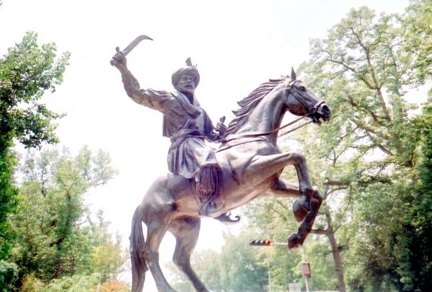
Despite commanding the largest rebel army of 1857 and being praised by the enemy as its ablest soldier, Bakht Khan is remembered mostly as a footnote to Bahadur Shah Zafar's tragedy. An equestrian statue of him stands in Delhi, but the national narrative of 1857 still centers on the emperor and the queens, not on the professional soldier who actually ran the war.
Source: Encyclopaedia Britannica, The Siasat Daily
Visuals: Archival portrait
Follow the daily five-post slate on Instagram.
Follow on Instagram
