
Bhogeswari Phukanani: The Mother of Eight Who Took a Bullet for the Flag
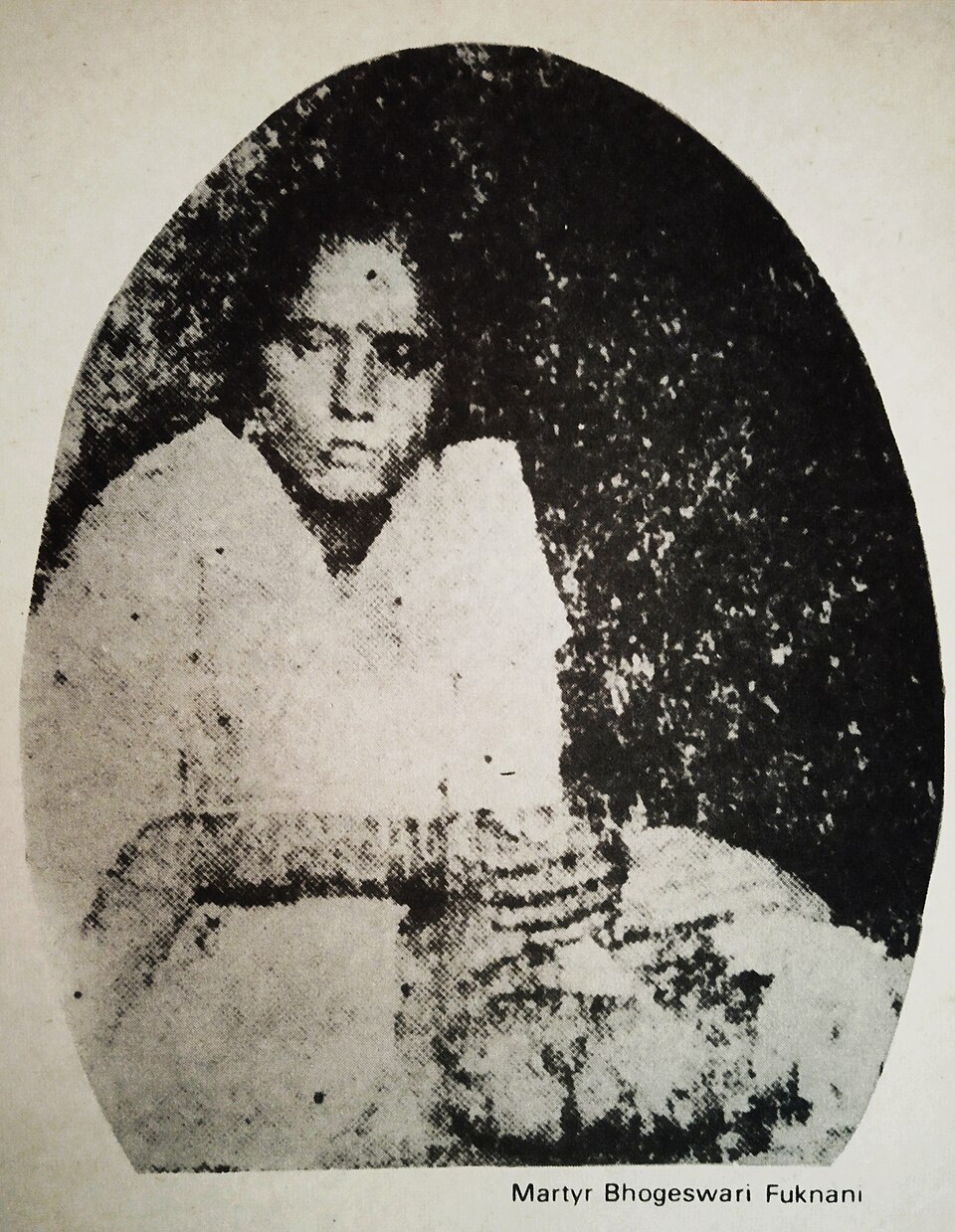
Portrait: Wikimedia Commons, public domain
Bhogeswari Phukanani was a mother of eight and a housewife in Nagaon district of Assam, and in September 1942 she stood in front of a British officer's revolver to defend the honour of the national flag. He shot her at point-blank range. She was about fifty-seven.
She was born around 1885 in Nagaon district, married Bhogeswar Phukan, and raised two daughters and six sons. She was no sheltered figure: she helped set up Indian National Congress offices in the Berhampur, Babajia and Barpujia areas, and in 1930 she took part in the Civil Disobedience movement, getting arrested for picketing. When the Quit India movement erupted in August 1942, she was in her late fifties and joined it without hesitation.
The confrontation came at Barhampur in September 1942. The local Congress office had been seized by the military and police, and revolutionaries had retaken it. To crush the celebration, the British sent a military force under a Captain Finish. People from nearby villages poured in with national flags, shouting Vande Mataram; Ratnamala led the procession with Phukanani beside her. When Captain Finish snatched the flag from Ratnamala's hands and it fell to the earth, Phukanani could not bear the insult to the flag. She rushed forward and struck the officer on the head with the flagpole in her own hand. A furious Finish drew his revolver and fired at her. She fell to the ground.
She did not die instantly. She was shot on 18 September and battled her injuries for two days, dying on 20 September 1942; some records give 21 September as the date of death. She never let go of the flag.
Folk songs and poems made in her honour call her Veerangana Bhogeswari Phukanani, and mothers in Nagaon district told her story to their children as an example of courage. Her path into the movement is worth noting: she was not a young firebrand but a woman in her late fifties with eight children, who had already been jailed once in 1930, and who chose, at an age when the movement could have asked nothing of her, to stand between a British officer and the flag. Assam's Quit India martyrs were disproportionately women like her: Kanaklata Barua died at Gohpur in the same week Phukanani was shot, which is why the state's memory of 1942 is carried as much by women's names as by men's.
Independent India has not entirely forgotten her. The Bhogeswari Phukanani Civil Hospital at Nagaon and an indoor stadium at Guwahati carry her name, and schools and roads across Assam commemorate her. But she remains a regional figure, because the documentation of her life is thin, a few paragraphs in movement histories and folk memory, and because she was an ordinary rural woman whose heroism lasted a single afternoon. The archival portrait that survives her, a grainy oval photograph, is almost the only trace of the woman herself.
Source: Assam Times, Wikipedia
Visuals: Archival portrait
Follow the daily five-post slate on Instagram.
Follow on Instagram
