Maruthu Pandiyar brothers: The rulers of Sivaganga who issued India's first proclamation of independence
Portrait: Wikimedia Commons, CC BY-SA 4.0
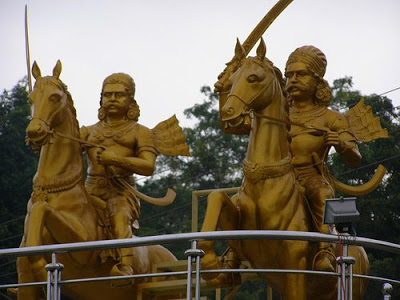
Periya Marudhu and Chinna Marudhu, known together as the Maruthu Pandiyar brothers, were the de facto rulers of Sivaganga in Tamil Nadu in the last two decades of the 18th century. The elder, Vellai Marudhu or Periya Marudhu, was born in 1748 and the younger, Chinna Marudhu, in 1753, both at Mukkulam. Their father was Mookiah Palaniappan Servai and their mother Anandayer, also known as Ponnathal. They rose through service as commanders under Muthuvaduganatha Thevar, the ruler of Sivaganga.
When Muthuvaduganatha Thevar was killed by the East India Company in 1772 over his refusal to pay taxes, the brothers escaped with his widow, Queen Velu Nachiyar, and took shelter with Gopala Nayak at Virupakshi for eight years. In 1789, an alliance of kingdoms led by the Pandiyars retook Sivaganga. Chinna Marudhu became the queen's minister and Periya Marudhu her commander-in-chief, and after Velu Nachiyar's death around 1790, the brothers ruled Sivaganga in their own right, building temples, tanks, and water bodies in a reign remembered as prosperous.
The brothers were renowned fighters and skilled craftsmen, said to be experts in the valari, the crescent-shaped Tamil throwing weapon, a variant of the boomerang. They worked closely with Veerapandiya Kattabomman of Panchalankurichi, and after the British hanged Kattabomman on 17 October 1799, Chinna Marudhu gave shelter to his brother Oomadurai, an act the British used as a pretext to move against Sivaganga.
On 16 June 1801, months before their deaths, the brothers issued what is often called the Jumboo Deweepa proclamation from the Tiruchi fort: a call to the people of all castes and communities of peninsular India to unite against European domination. Historians describe it as the first proclamation of independence issued against British rule in India, and one with an all-India conception, warning that if the political decay continued, India would fall wholly under alien rule.
The rebellion of 1801, known as the South Indian Rebellion, was fierce. The Marudhu forces captured territory and fought the British and their allies at Kalayar Koil, Virupakshi, Dindigul, and Cholapuram. British reinforcements were rushed from overseas to put the rising down. The brothers were finally captured at Cholapuram and hanged at the fort of Tirupputhur on 24 October 1801. Their sons, grandsons, commanders, and servants were executed alongside them; The Hindu, citing the Tiruchirapalli Proclamation, reports that 530 of their family members, followers, and chieftains were executed.
More than half a century before the 1857 uprising, the Maruthu brothers ran a kingdom, built an army, sheltered fugitives, and issued a written call for a united Indian resistance. Their memorial stands at Kalaiyarkoil, and their sacrifice is observed as Guru Pooja, yet their war remains a footnote in most textbooks.
Source: The Hindu, Scroll.in, Wikipedia
Visuals: Archival portrait
Follow the daily five-post slate on Instagram.
Follow on Instagram