Puli Thevar: The Tamil poligar who defied the British a century before 1857
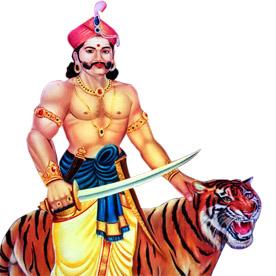
Portrait: Wikimedia Commons, CC BY-SA 3.0
Puli Thevar was a Tamil palayakkarar (poligar) who ruled Nerkattumseval, in the Sankarankoil taluk of what is now Tenkasi district in Tamil Nadu. He was born on 1 September 1715 to Chitraputra Thevan and Sivagnanam Nachiyar, and belonged to the Hindu Marava community. His wife was Kayalkani Nachiyar. He was a devotee of Lord Shiva, and in Indian exam-prep and historical sources he is often described as the first Hindu native ruler in the subcontinent to take up arms against the British East India Company.
His quarrel began over revenue. The Nawab of Arcot, backed by the British, demanded tribute that the poligars considered an usurpation of their traditional authority. Puli Thevar refused to pay the customary rice tribute to the Nawab, and his territory became known as Nelkatumseval, roughly "the place that does not pay rice tribute." From 1755, he organised a confederacy of the Western poligars and successfully repulsed the joint expedition of the British officer Alexander Heron and the Nawab's commander Mahfuz Khan. He forged ties with Hyder Ali of Mysore and with French officers to secure artillery support.
For about sixteen years, from 1750 to 1766, he held his ground against the combined Anglo-Nawab forces, a stretch of battlefield dominance against a European power that was remarkable for its time. He crushed three of the Nawab's Pathan generals, Mudemiah, Mian, and Nabi Khan, and when military means failed, the Nawab-British alliance tried to buy him off with large land grants, which he refused.
The alliance then recruited Yusuf Khan, also known as Marudhanayagam, an Indian commander who switched sides. After a prolonged campaign, Yusuf Khan captured Nerkattumseval in 1761 following a long siege. Puli Thevar recaptured his fort in 1764 after Yusuf Khan was executed by his own overlords, but the Company pressed on, and he was finally defeated by Captain Campbell in 1767. He died on 16 October 1767 at Tenkasi, though some accounts leave the exact circumstances of his end uncertain.
Puli Thevar's rebellion ran from the 1750s to the 1760s, nearly a century before the revolt of 1857 that textbooks treat as the beginning of armed resistance. He pioneered the confederacy model that later poligars such as Kattabomman and the Maruthu brothers would adopt, yet outside Tamil Nadu his name is barely known, and even the details of his death remain contested. A statue of him stands at his palace in Nerkattumseval, and in recent years Doordarshan has broadcast a serial on his life as part of its series on Indian freedom fighters.
Source: GKToday, Wikipedia, Hindu Post
Visuals: Archival portrait
Follow the daily five-post slate on Instagram.
Follow on Instagram