Uda Devi: The Dalit sharpshooter of Sikandar Bagh, 16 November 1857
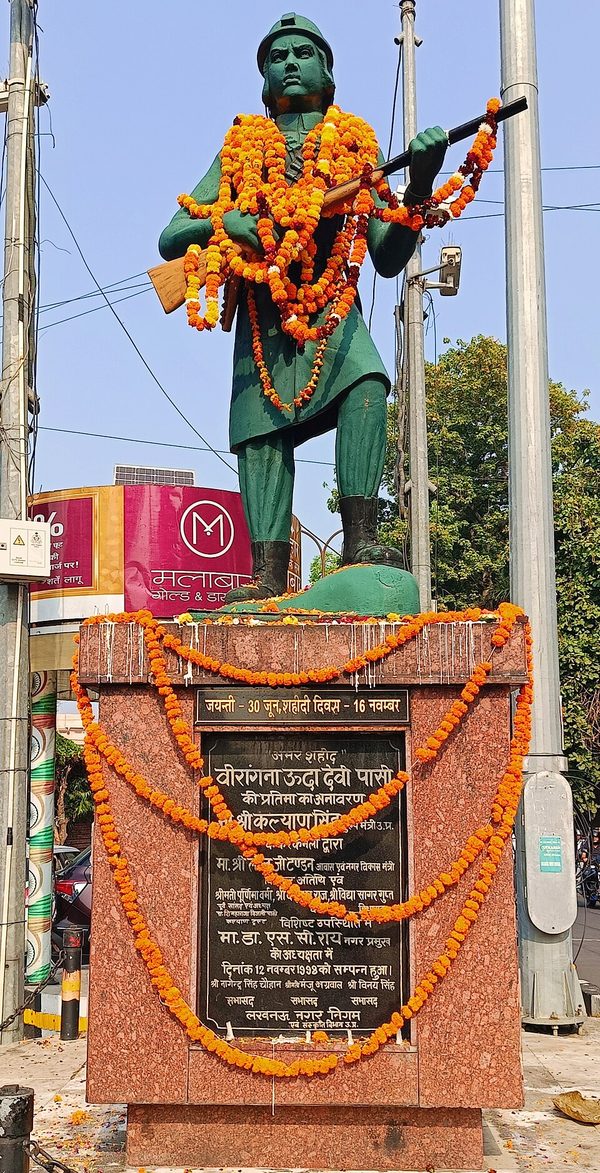
Portrait: Wikimedia Commons, CC BY-SA 4.0
Uda Devi Pasi (1830-1857) was a Dalit woman warrior who fought the British at the Battle of Sikandar Bagh in Lucknow and is remembered today as one of the "Dalit Veeranganas" of 1857. She was born on 30 June 1830 in Ujariya village, now Gomti Nagar in Lucknow, into a Pasi family, a community the British would later classify as a "criminal tribe" under the 1871 Act. She married Makka Pasi, a soldier in the Nawab of Awadh's army. Some accounts say he was martyred on 10 June 1857 fighting the British near Chinhat, close to Lucknow. The Pasi community is the second-largest Scheduled Caste group in Uttar Pradesh. She served in the women's battalion of Wajid Ali Shah, the last Nawab of Awadh, and after his deposition approached Begum Hazrat Mahal to enlist for the war. The Begum helped her form and command a women's battalion of her own.
When her husband died in battle, she resolved to fight on in full force. On 16 November 1857, as British forces advanced on Lucknow, she climbed a large peepal tree at Sikandar Bagh and, disguised as a male soldier, shot at the advancing troops from above. Popular accounts, including the research of historian Badri Narayan, credit her with killing 36 British soldiers before she was spotted. A British eyewitness, Sergeant William Forbes-Mitchell, recorded in his Reminiscences of the Great Mutiny that from her carefully prepared perch she had "killed more than half-a-dozen men," and described her as armed with a pair of heavy old-pattern cavalry pistols, one still loaded in her belt, her pouch still half full of ammunition. British troops fired into the trees and she fell to the ground, covered in blood. Only when her helmet was removed did they realize the sniper was a woman.
She was 27. Even British accounts recorded respect for her courage, and her story appears in Crispin Bates and Marina Carter's Mutiny at the Margins as an instance of British officers bowing to a rebel's bravery.
Upper-caste histories centered Rani Lakshmibai, and Dalit fighters like Uda Devi were left out of the national narrative for over a century. As historian Rana Safvi has written, while 1857 is remembered through Rani Lakshmibai and Begum Hazrat Mahal, women from the "depressed classes," called Dalit Veeranganas by scholars, fought alongside them, aided by innkeepers, performers, and courtesans who sheltered rebels and passed on news. Today a statue of her stands at Sikandar Bagh, her martyrdom day on 16 November is observed annually, and in November 2024 Defence Minister Rajnath Singh and Chief Minister Yogi Adityanath unveiled another statue of her in Lucknow. She is remembered now as a symbol that 1857 was fought across caste lines, not only in palaces.
Source: The Indian Express, Hindustan Times
Visuals: Archival portrait
Follow the daily five-post slate on Instagram.
Follow on Instagram